The Shift Change Blind Spot: How Manufacturing Teams Stop Losing Critical Process Knowledge
By mdavidson


For production engineers, manufacturing engineers, plant managers, and manufacturing leaders.
At 6:00 a.m., the next shift takes over a filling line. The outgoing team says the line is running. What they may not say is that the upstream mixer ran warm for twenty minutes, a valve was adjusted, inspection rejects rose briefly, and maintenance is still waiting to verify the repair. None of those facts alone tells the story. Together, they could explain the next shift's quality problem.
The problem isn't that plants lack data. It's that the next team inherits a status update instead of an evidence-backed understanding of the process.
What good handover guidance actually says
The UK Health and Safety Executive (HSE) defines the purpose of handover as the “accurate reliable communication of task-relevant information”. Its guidance calls for preparation, a two-way exchange, and cross-checking by the incoming team. HSE also recommends verbal and written communication together—not one replacing the other.
That matters because a dashboard cannot confirm that the incoming engineer understood an unresolved risk. Nor can a verbal conversation reliably reconstruct every event that preceded an abnormal condition. HSE's inspection guidance highlights current operating status, ongoing work, procedure changes, equipment out of service, and safety-system overrides as information to transfer.
In the United States, OSHA's Process Safety Management standard, where applicable, requires accessible operating procedures and management of changes to covered processes. These requirements are not a claim that every factory is subject to PSM. They illustrate a broader operating principle: a process change must be understood by the people who inherit it.
The four questions every incoming shift should be able to answer
- What changed? Capture setpoint changes, material or lot transitions, equipment adjustments, work orders, abnormal alarms, and deviations from normal conditions—with timestamps.
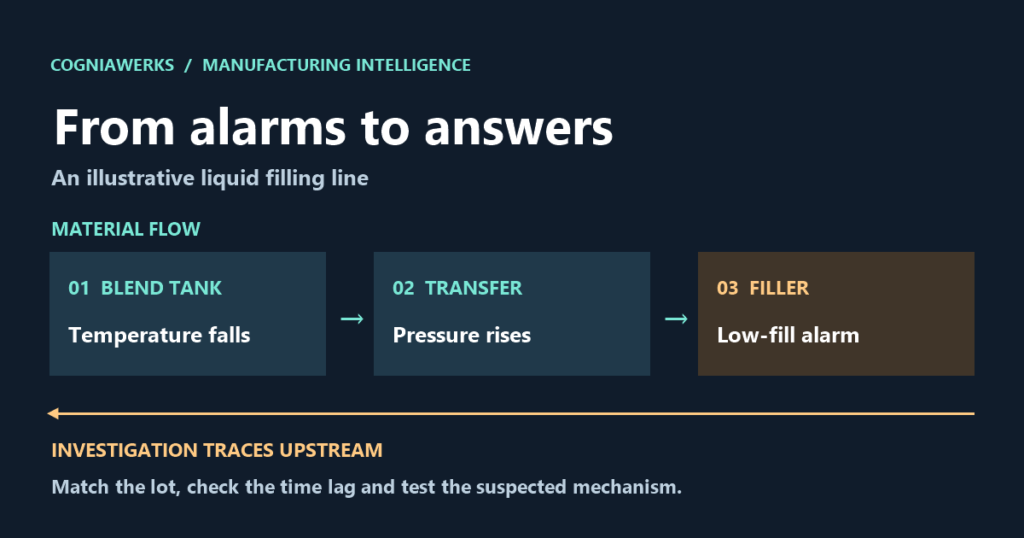
- What did the change affect? Connect events to upstream and downstream operations. A filling reject may be a symptom of an earlier mixing or temperature deviation.
- What remains unresolved? Distinguish verified fixes from working hypotheses, open maintenance work, quality holds, temporary operating limits, and items requiring supervisor approval.
- What should we watch next? Give the next shift specific assets, conditions, and checks rather than a generic instruction to “monitor closely.”
From a shift log to a process-aware handover
Consider a hypothetical packaging operation. The night shift sees a ten-minute rise in fill-weight variability. Operators adjust a filler setting, and variability falls. A conventional handover might read: “Filler adjusted; running normally.”
A process-aware handover asks whether the setting was the cause or merely a response. It correlates the filler event with upstream temperature, material-lot changes, equipment states, inspection results, and maintenance notes. The handover then records a timeline and supporting evidence:
- 02:14 — upstream temperature deviated from the normal operating band.
- 02:22 — fill-weight variation increased.
- 02:29 — operator adjusted the filler; reject rate subsequently declined.
- 06:00 — causal relationship not yet confirmed; incoming team should verify the upstream condition and quality disposition.
Illustrative example only; these are not actual customer results.
That is a better engineering handover because it separates observations, actions, and unverified explanations. It also tells the next team where to start.
Where DMI fits
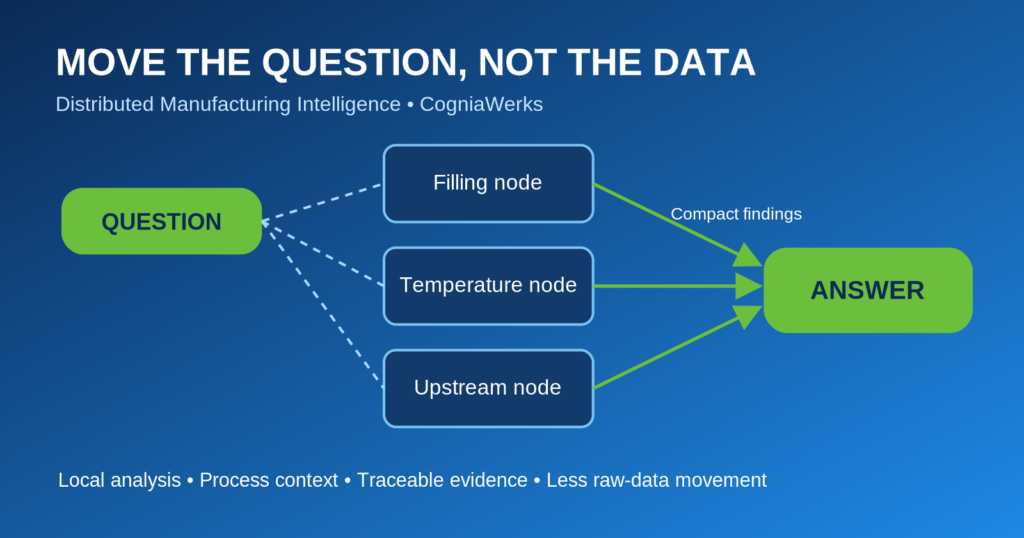
CogniaWerks Distributed Manufacturing Intelligence (DMI) is designed to connect operational evidence across equipment, plant systems, and technical documents without requiring a wholesale replacement of existing systems. Its process-aware graph provides the context to investigate what happened upstream, what changed downstream, and which evidence supports a possible explanation.
For a shift handover, that creates the foundation for a more useful briefing: relevant deviations, open investigations, equipment and process context, links to source evidence, and questions requiring human confirmation. The objective is not to automate away the conversation. It is to make that conversation specific, complete, and checkable.
HSE's guidance is clear that effective handover should be two-way. DMI can support that workflow with evidence; it should not be treated as a substitute for trained operators, site procedures, approvals, or safety-critical communication.
What plant managers and CEOs should measure
A better handover is valuable only if it changes operating performance. Start with a single line and measure:
- Repeat investigations: how often the incoming shift has to rediscover an issue already investigated.
- Time to context: minutes needed to understand an abnormal condition after handover.
- Open-item closure: whether actions have an owner, evidence, and verified completion.
- Quality escapes and rework: whether unresolved process changes are detected before more product is made.
- Downtime and throughput: whether clearer context reduces avoidable stops and prolonged troubleshooting.
Do not assume an AI system improved those metrics merely because it produced a summary. Compare performance against a baseline and review the results with the people running the line.
Start with one shift, one line, one recurring issue
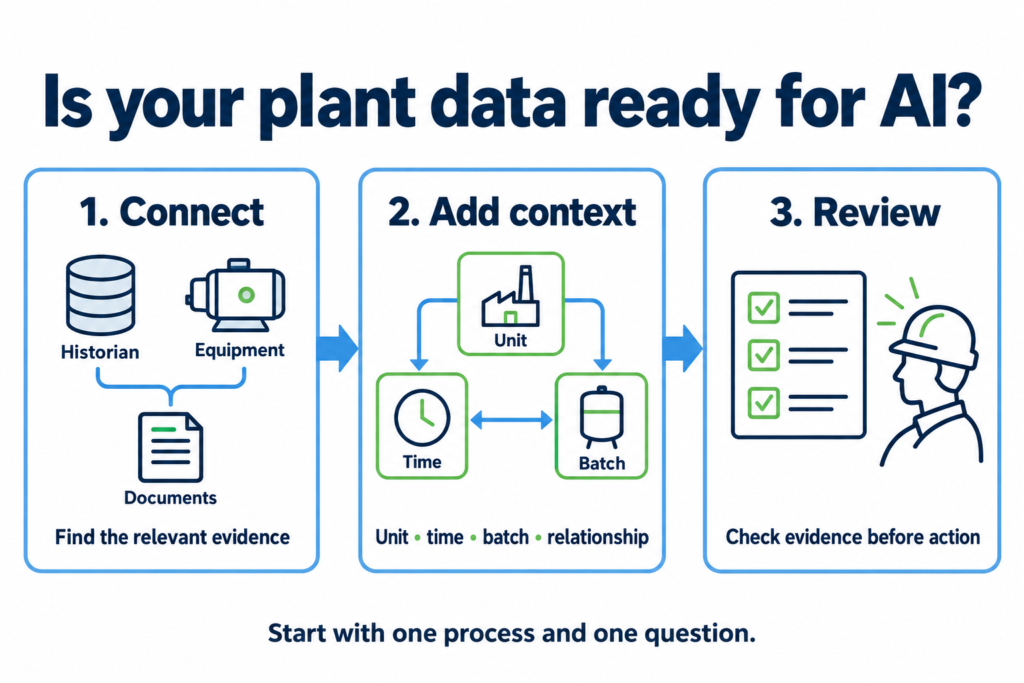
Choose a line with frequent handover questions. Map the few systems that matter—historian, alarms, maintenance, quality records, and shift notes. Define the information the incoming shift needs, then test whether a process-aware evidence brief makes the handover more reliable. Keep the face-to-face discussion and required sign-offs.
Manufacturing intelligence earns trust when it helps the next engineer make a better decision, not when it generates a prettier report.
External references
- UK HSE — Shift handover: three-part handover process and practical communication principles.
- UK HSE — Inspection of Loss of Containment: process operator shift/crew handover expectations.
- OSHA — 29 CFR 1910.119: operating procedures and management of change for covered processes.
- UK HSE — Permit to work systems: communication when work continues across shifts.
See what process-aware evidence looks like on your line. Request a DMI demonstration.
See DMI on your process
Book a tailored walkthrough with our team.