Move the Question, Not the Data: Why Industrial AI Stalls at Plant Scale
By mdavidson
By Mark Davidson, CEO
Distributed Manufacturing Intelligence starts from a question most AI roadmaps skip: what happens to your architecture when the pilot works? A model that explains a pressure excursion on one skid looks brilliant in a demo. Then someone asks it to do the same for every line, every historian and every site, and the project quietly stalls.
The model is rarely the problem. The plumbing is. Most industrial AI is built on one assumption: to ask a question, you first have to move the data to wherever the model lives. That works for one asset. It breaks long before it reaches a whole plant.
Why moving the data stops working
Plant data was never designed to sit in one place. PLCs, SCADA, historians, MES, QMS, LIMS, databases and files each sit in their own system and network, each with its own access rules. Centralizing it runs into three kinds of limits at once.
- Not permitted. Trade secrets and process IP, data sovereignty, export controls such as ITAR, GxP validation, customer contracts and OT security policies can limit what leaves a site.
- Not practical. Plants generate more data than anyone wants to ship. Bandwidth, latency, transfer and AI token costs grow with every asset added to a question.
- Not defensible. Regulated and high-value sites need a traceable evidence trail. “The AI said so” does not pass an audit.
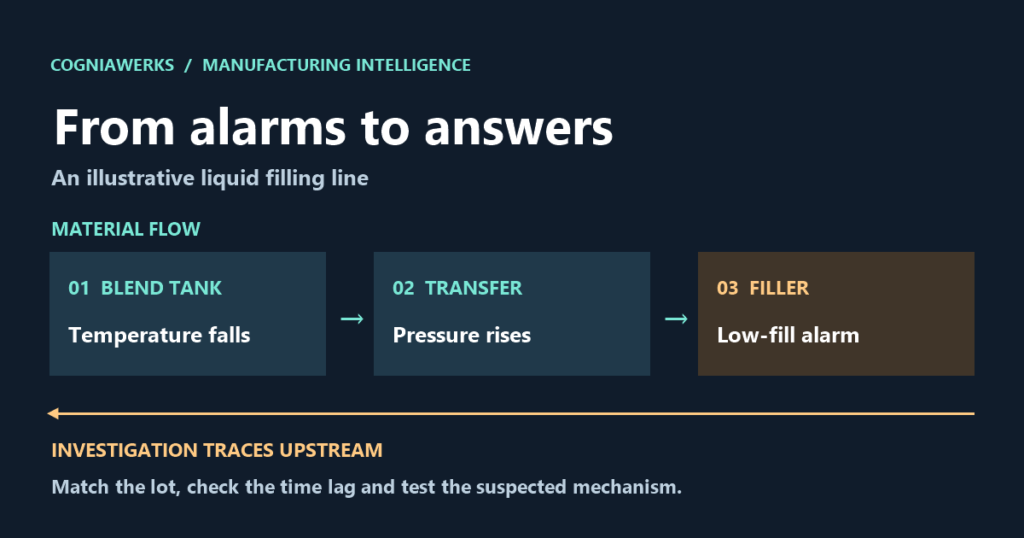
The cost of getting this wrong isn't abstract. Siemens estimates that unplanned downtime costs the world's 500 largest companies about $1.4 trillion a year, roughly 11% of revenue (Siemens, The True Cost of Downtime 2024). Much of the investigation time goes to working out what happened first.
The better approach: send the question to the data
The alternative is simple to say: data stays where it is; intelligence moves.
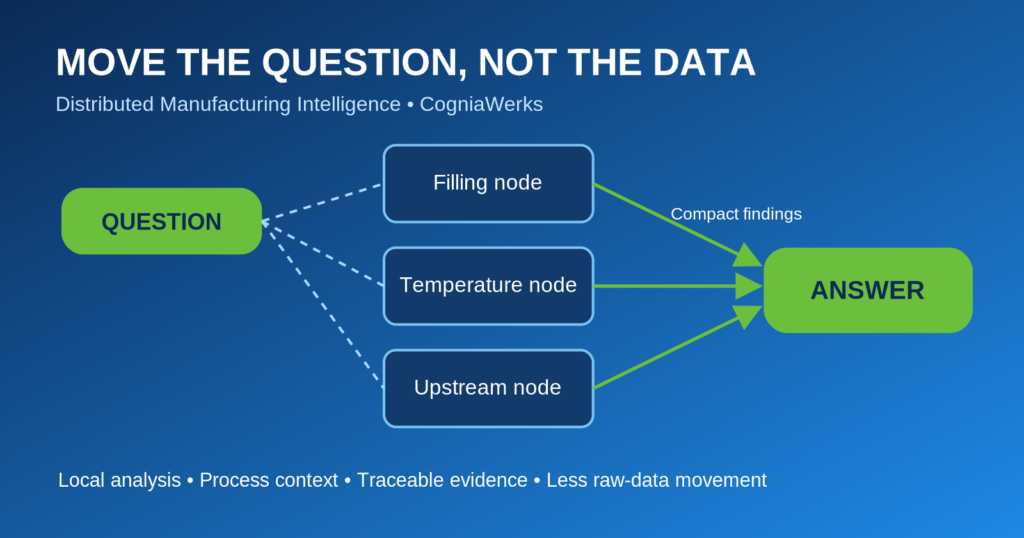
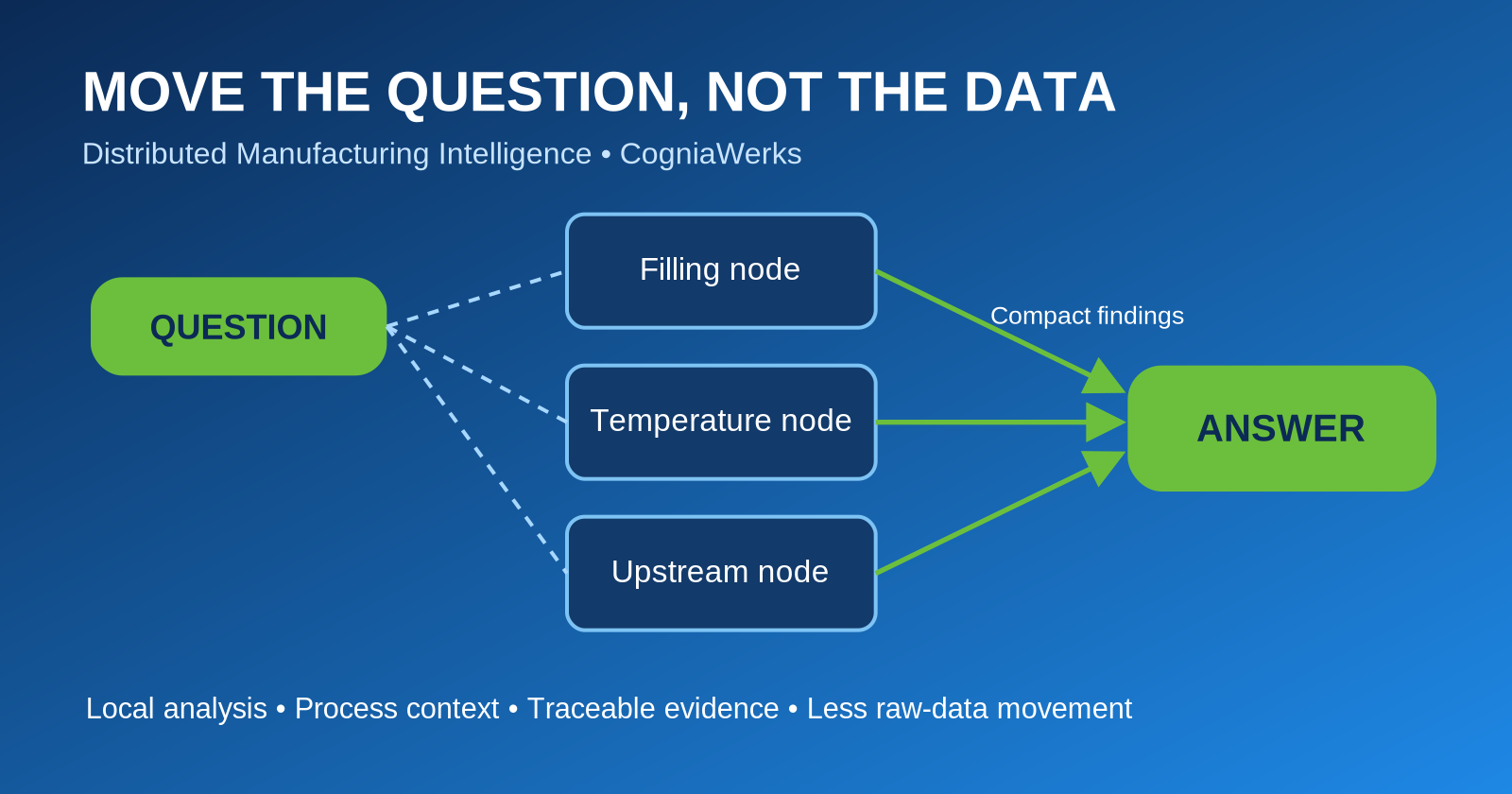
Instead of pulling raw readings to a central model, the question travels to the parts of the plant that hold relevant data. Each local node does its own analysis and sends back a compact finding, not a data dump. Only those findings are combined into the answer.
Industrial AI should scale with the factory, not force the factory to scale a central AI bottleneck.
How a distributed investigation works
Take a familiar question: Why did filling throughput drop?
- Fan out. The plant-level question is split into narrow analytical tasks sent only to relevant nodes: filling, temperature, upstream process.
- Analyze locally. Each node works on its own data inside the plant's security boundary.
- Return evidence. Each node sends back a typed result: asset, time window, units, events, anomaly score, confidence, lineage and model version.
- Join along the process. Findings are combined using process relationships, upstream events, time lags and downstream effects. The explanation is written from evidence, with sources cited.
The output is an investigation an engineer or QA reviewer can check, not just a confident paragraph.
What changes when intelligence moves
1. Data movement stays small as scope grows
In a centralized design, every asset added means more raw data shipped per question. When only findings travel, the size of the answer depends on the question, not the size of the plant.
In a single-node test on a biopharma process (about one million historian readings), the distributed approach moved roughly 606 times less data and used roughly 225 times fewer AI tokens per question than putting raw data in a prompt. It needed one model call instead of four because the raw-data prompt did not fit in a 200,000-token context window. These figures describe that specific test, not a guaranteed result for every deployment.
2. Cost doesn't recur on raw data
Cloud AI bills on what you send it. If every question carries raw readings, the cost of curiosity rises with every tag. Sending compact findings can keep per-question cost low so teams can investigate more often.
3. The plant keeps working when the network doesn't
Plant networks are segmented, bandwidth-limited and sometimes offline. Centralized analysis may stop when the WAN link drops; local nodes can keep working on local data.
4. Each new line adds capacity, not just load
With central AI, a fixed cluster can become the bottleneck. In a distributed design, each new node brings local compute and joins the same data fabric, reducing the need to rebuild pipelines.
5. Compliance becomes easier to scope
Keeping raw data inside the site can reduce data-export approvals, although security, validation and regulatory obligations still need to be assessed for each deployment.
6. Every answer has a paper trail
Each finding can carry its node, time window, model version and source query, allowing the final answer to be traced step by step. That's the difference between an AI opinion and an investigation record.
What this means for DMI
This is the architecture behind CogniaWerks DMI (Distributed Manufacturing Intelligence). DMI runs on plant edge nodes beside existing systems and reads them in place, read-only by default, through the AnyLog distributed data fabric. It uses the plant's process graph to decide which nodes to ask and how to join what they return. Each system answers questions about its own data. DMI answers the questions that cross them, with evidence attached.
Getting started
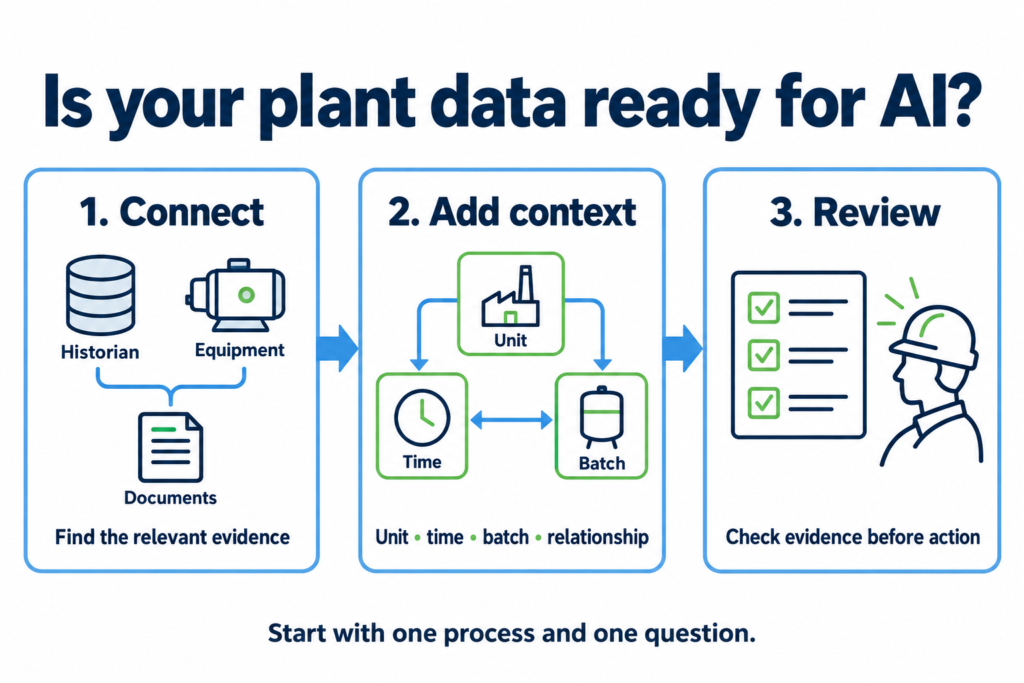
You don't need to centralize everything to try this. Pick one recurring problem on one line, such as a throughput dip, quality event or unexplained alarm pattern. Connect the systems that line already uses in place, and measure how long the next investigation takes against the previous one. Then decide whether the next line should work the same way.
See DMI on your process
Book a tailored walkthrough with our team.
See DMI on your process
Book a tailored walkthrough with our team.