Manufacturing AI Data Readiness: Start With Process Context
By Mark Davidson, CEO
A quality engineer opens yesterday’s rejected batch. The temperature history is in the historian, the batch identity is in MES, and the inspection result is in the quality system. Each record exists. The work is proving that they describe the same material, equipment and moment.
Manufacturing AI data readiness starts with that connection. Before asking a model to explain a loss, establish which evidence belongs in the investigation and how a person will check the answer.
Why more data does not settle the question
The 2026 manufacturing AI roadmap listed by NIST identifies data management, integration with heterogeneous sensing and control systems, and trustworthy operation as continuing industrial AI challenges. Those are practical engineering tasks, not problems a conversational interface removes.
A useful readiness test is simple: can another engineer reconstruct the event from the evidence without asking the person who assembled the spreadsheet? If the answer depends on an undocumented tag alias or an unexplained time offset, resolve that gap before treating the analysis as decision support.
Five checks before the first AI investigation
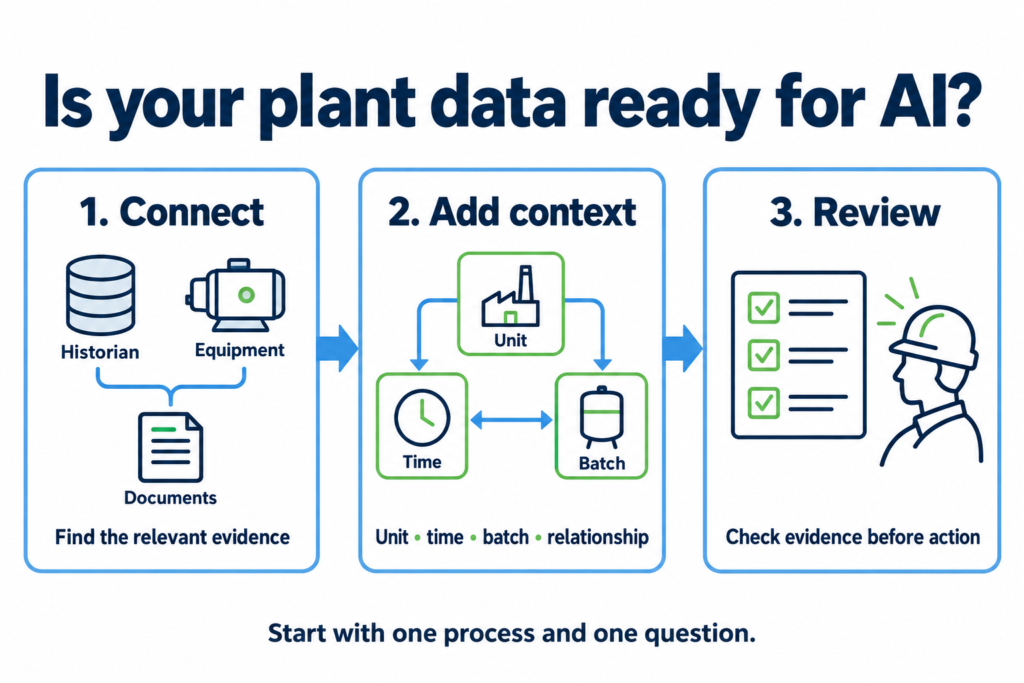
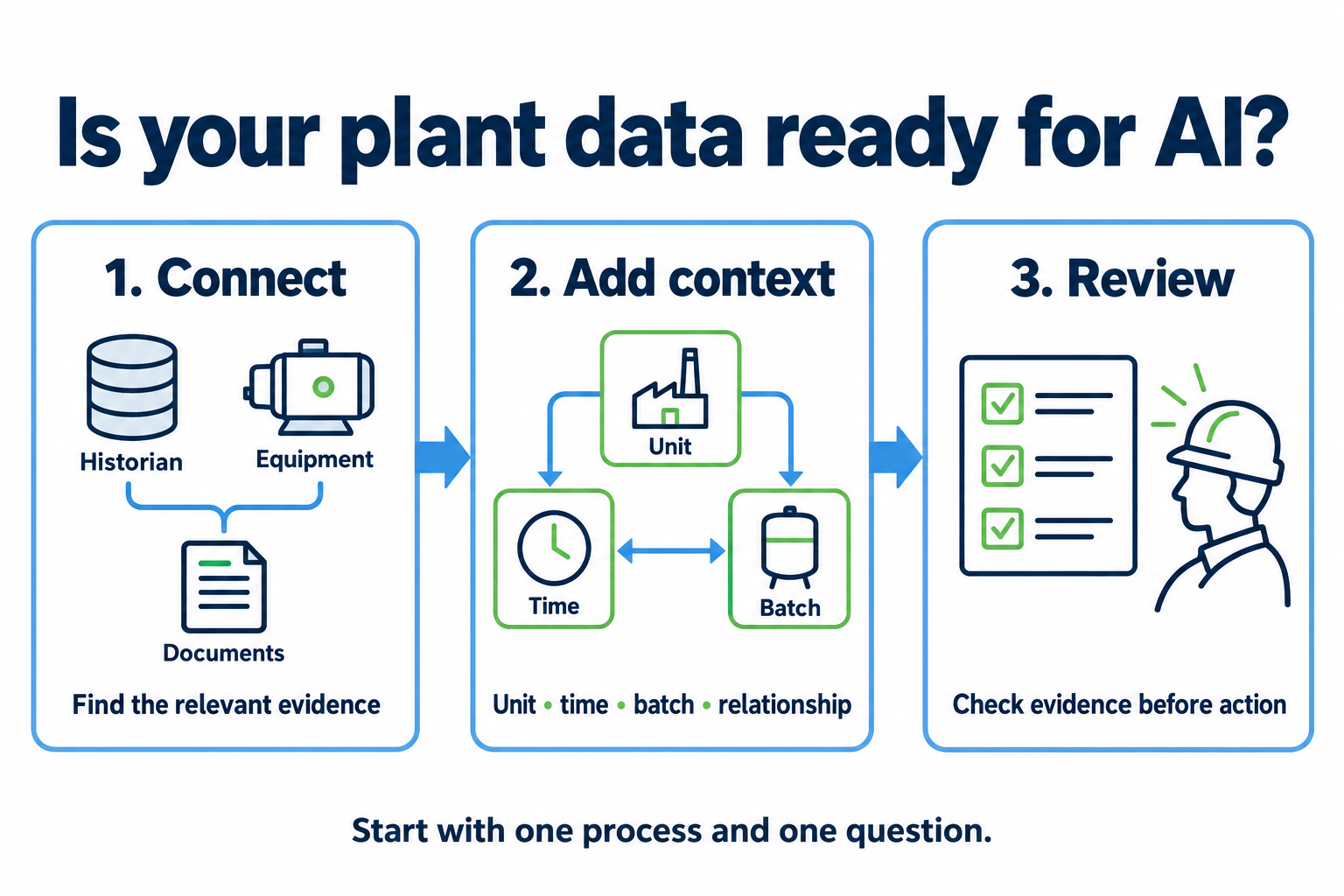
1. Give every measurement a process identity
Record the site, line, unit and measurement meaning. Include engineering units and distinguish a setpoint from an actual reading. A pressure value from a parallel line may look relevant while having no physical path to the batch under review.
CESMII’s March 2026 discussion of AI-ready manufacturing data emphasizes site-approved information models and data labeled for interpretation and reuse in its operating context. Apply that principle by having plant staff review the mapping rather than assuming familiar names mean identical things.
2. Align time and production context
Check clock synchronization, time zones, sampling intervals and process delays. Tie measurements to the relevant batch, recipe, order or operating mode when those records are available. A laboratory result posted at noon may describe material sampled hours earlier. Joining it to noon’s process values can build a convincing explanation of the wrong event.
3. Keep quality and provenance visible
Identify missing readings, stale values, sensor changes and maintenance periods. Preserve the source and transformation history so a reviewer can trace an indicator back to the records behind it. NIST’s Advanced Manufacturing Data Infrastructure and Analytics program places collection, transformation, traceability and interoperability within the foundation for trusted analytics.
4. Map the relationships that an investigation can follow
A shared name helps find data. A reviewed process relationship helps decide whether it belongs in the explanation. Document which unit feeds the next stage, where material transfers and which measurements describe the result. Treat an upstream association as a candidate to investigate; a graph connection and a matching trend do not, by themselves, prove causation.
5. Decide how the answer will be reviewed
Define the decision, evidence required and responsible reviewer before generating recommendations. Keep missing evidence visible. A useful result should let the engineer challenge the selected time window, inspect the contributing readings and reject an explanation that does not fit the process.
A filling-line example
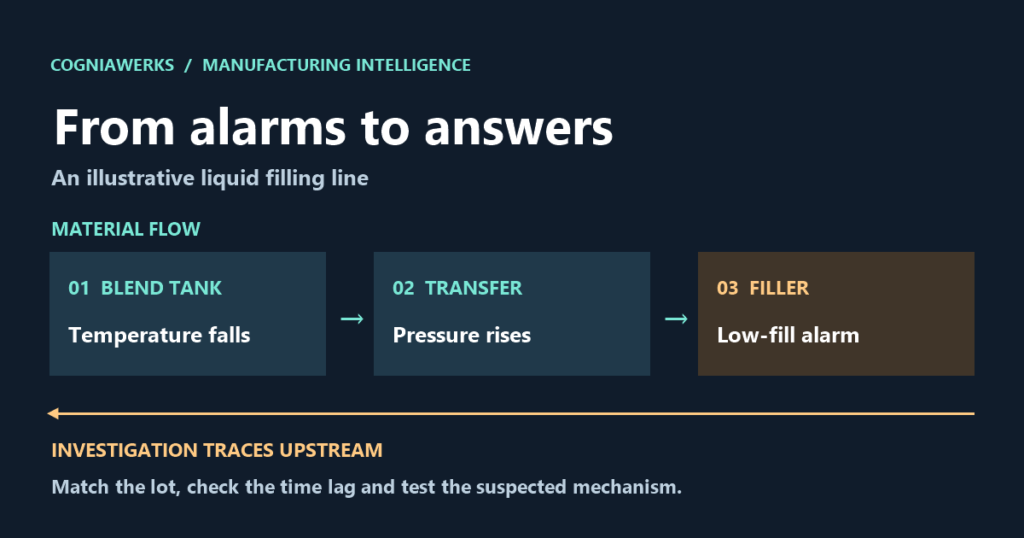
Consider a hypothetical line with intermittent underfills. The filler’s reject count rises after a change in upstream supply pressure. Before naming pressure as the cause, verify that both measurements belong to the same line, account for the material’s travel time, and compare the event with operating mode and maintenance records.
If the pressure sensor was being serviced, or the reject counter was reset during the window, the apparent relationship needs another explanation. The value of contextualization is making those checks possible before someone changes a setpoint. This example illustrates an investigation approach; it is not a customer result or a claim of measured DMI performance.
Where DMI fits
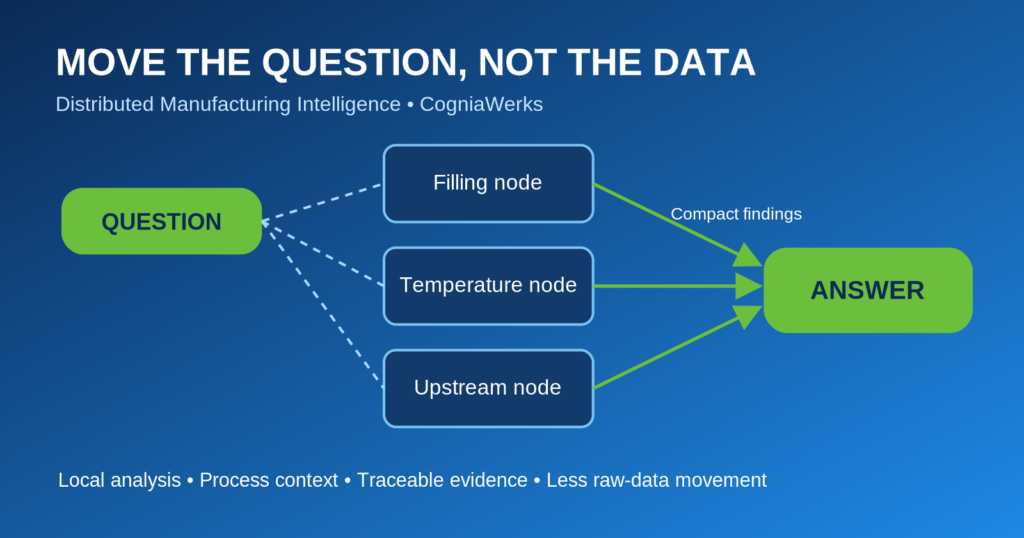
CogniaWerks Distributed Manufacturing Intelligence brings plant data, technical documents and process relationships into an investigation. Existing control and business systems retain their roles. DMI uses data made available through the AnyLog fabric and indexed technical documents; source access and reviewed mappings still matter.
A reviewed unified namespace provides process identity. The process graph helps scope the units, relationships and time window used in analysis. Core intelligence runs on the plant network, and the local language model can explain the resulting evidence. That architecture supports investigation; it does not repair a faulty sensor or turn an unverified relationship into a confirmed cause.
The same process context supports the DMI process twin. Its decision-support projections should be assessed against the process and their assumptions before a change is approved.
Start with one question your team already asks
Choose one recurring quality or production issue on one line. Identify the required measurements and documents, review their meaning with the people who run the process, and replay a known event. Record what the evidence explains and what remains uncertain.
Use that exercise to define your next integration task. A missing batch link, an inconsistent clock or an unreviewed unit mapping is a concrete problem the team can fix. Manufacturing AI data readiness becomes useful when it is tied to a decision someone actually needs to make.
References
- Vogl, G., Cornelius, A., and Jia, X. 2026 Roadmap on Artificial Intelligence and Machine Learning for Smart Manufacturing. IOP Publishing; NIST publication listing, July 3, 2026.
- CESMII. Data Sharing, AI-ready Data and Data-first Smart Manufacturing: an Industry Coalition Experience – NIST/NSF Workshop Study. March 25, 2026.
- NIST. Advanced Manufacturing Data Infrastructure and Analytics Program. Updated July 17, 2026.
See DMI on your process
Book a tailored walkthrough with our team.