Share the Metadata, Not the Data: The Advantages of Distributed Data for Manufacturing
By Mark Davidson, CEO
For two decades, the standard answer to scattered industrial data has been the same: move it. Pipe PLC tags into a historian, push the historian into a data lake, copy the data lake into a cloud warehouse, and only then start asking questions. Each hop adds delay, cost and another copy to secure.
A different architecture is gaining ground. Edge data fabrics such as AnyLog, and its open-source counterpart EdgeLake from the Linux Foundation, leave operational data where it's created and share only the metadata that describes it. Applications and AI then query the whole operation as if it were one system. This article explains the difference and why it matters for manufacturers.
Data and metadata are not the same thing
- Operational data is the high-volume stream of readings: temperatures, pressures, counts, torques, states. It's created every second on every line, and it's what you'd normally ship to the cloud.
- Metadata describes that data: which asset a tag belongs to, what it measures, its units, where it's stored, how assets relate to lines, plants and processes, and who is allowed to see it. It's small and changes slowly.
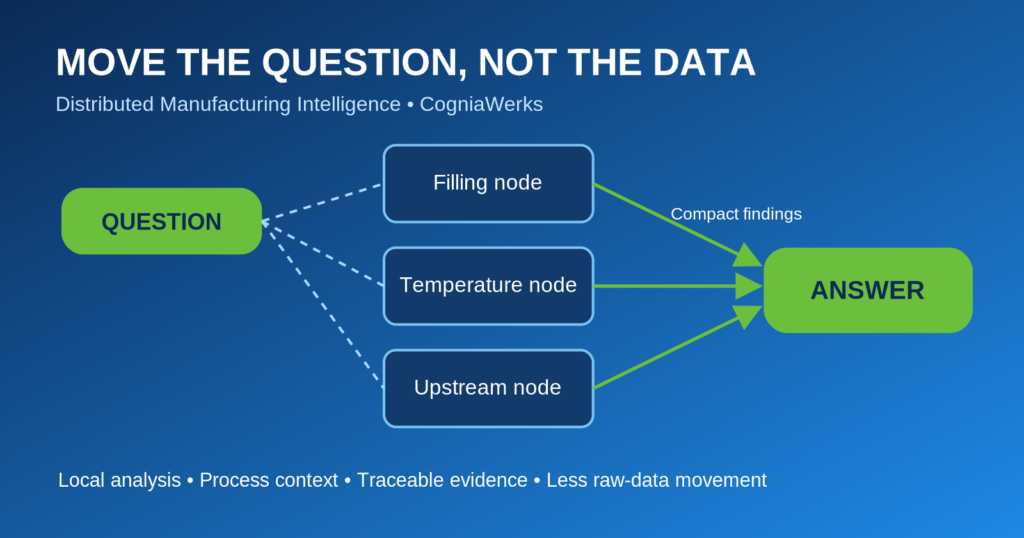
The key idea is to share the metadata across the network and keep the data at its source. Every node knows what exists and where, so a query can find the right data without anyone first collecting it in one place.
Processing moves to the data. Only the metadata, and the answers, travel.
The advantages
1. Real-time answers, not yesterday's copy
When data has to be extracted, transformed and loaded before anyone can use it, decisions are made on a delayed copy. Querying data where it lives means operators, applications and AI see the current state of the line, not the state when the last batch job ran.
2. Lower cost
Shipping every signal to the cloud means paying for bandwidth, egress, ingestion and storage, often several times over as the same data is copied between systems. A distributed approach processes and aggregates locally and sends only results, so you pay to move kilobytes of answers instead of terabytes of raw readings.
3. Ownership, sovereignty and security
Edge nodes can run inside the plant's firewall, connect to each other over authenticated, encrypted peer-to-peer links, and enforce their own access policies. Process data and the intellectual property it contains never have to leave the premises. Partners, vendors and AI models get access to answers, not custody of the source data, and privacy is enforced by where the data physically sits rather than by a cloud contract.
4. Resilience when the network isn't there
A plant can't stop because the WAN link went down. When data, processing and rules run locally, each site keeps working on its own and rejoins the wider network when the connection returns. Replication between nodes protects against the loss of a single device.
5. Scale one node at a time
Centralized architectures tend to be all-or-nothing projects. A distributed fabric starts with one machine, line or plant, and each new node simply joins the same logical system. Applications don't have to be rebuilt and central pipelines don't have to be re-engineered as you grow. First use cases can be running in days rather than months.
6. Many views of the same data, without copies
Because the structure lives in metadata, you can define several unified namespaces (UNS) over the same underlying stores: one organized for production, one for maintenance, one for energy, one for quality, one for management. Each team gets the hierarchy that makes sense to them, and none of them requires another copy of the data or another broker in the middle.
7. Context that AI can actually use
AI agents need more than raw values. They need to know how assets, processes, locations and systems relate to each other. A knowledge graph built from shared metadata gives them that map, and interfaces such as the Model Context Protocol (MCP) let agents and assistants query live edge data in plain language. The result is AI that reasons over the whole operation without a data lake behind it.
How a distributed query works
- A user, application or AI agent asks a question, for example: how many bottles were capped across all plants this shift?
- The shared metadata tells the network which nodes hold the relevant data.
- The query is sent to those nodes, and each one computes its part locally.
- Partial results are combined and returned as a single answer. The raw readings never left their plants.
What this means for DMI
 AnyLogPowered by the AnyLog Edge Data Fabric
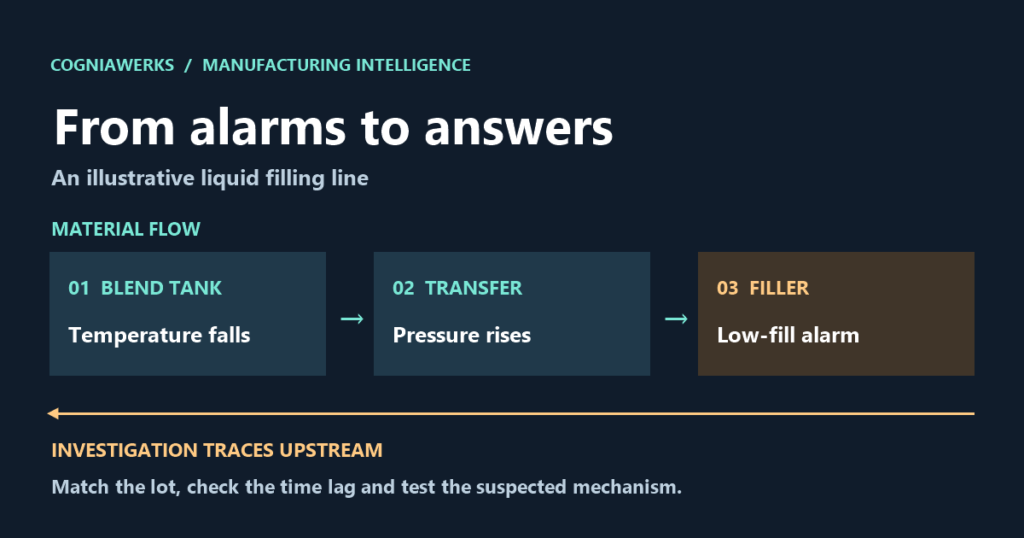
DMI (Distributed Manufacturing Intelligence) runs on top of AnyLog. Root-cause analysis depends on two things: live data and context about how the process fits together, and AnyLog's edge data fabric provides both. Its metadata layer, unified namespaces and knowledge graph describe the process, so DMI can trace cause and effect upstream across lines, systems and sites. The data stays in the plant, so DMI's analysis and AI run where the data lives, inside your security boundary, without a central data lake.
The result is industrial AI that is faster to deploy, cheaper to run, and safer to trust with your most sensitive operational data.
Getting started
You don't need to re-architect the whole enterprise. Pick one line with a recurring problem, connect its PLCs, historian and quality data in place, and ask the questions you can't answer today. Then add the next line. If you'd like to see this on a process like yours, request a demo.
See DMI on your process
Book a tailored walkthrough with our team.