How to Check a Manufacturing Process/Digital Twin Before Acting
By mdavidson
A line engineer wants to know whether a faster filler will increase finished cases per hour. The filler can run faster on its own, but the packer may already be close to its limit. Before relying on a manufacturing process twin for that decision, replay a change the plant has already measured.
Choose a decision and a recorded event
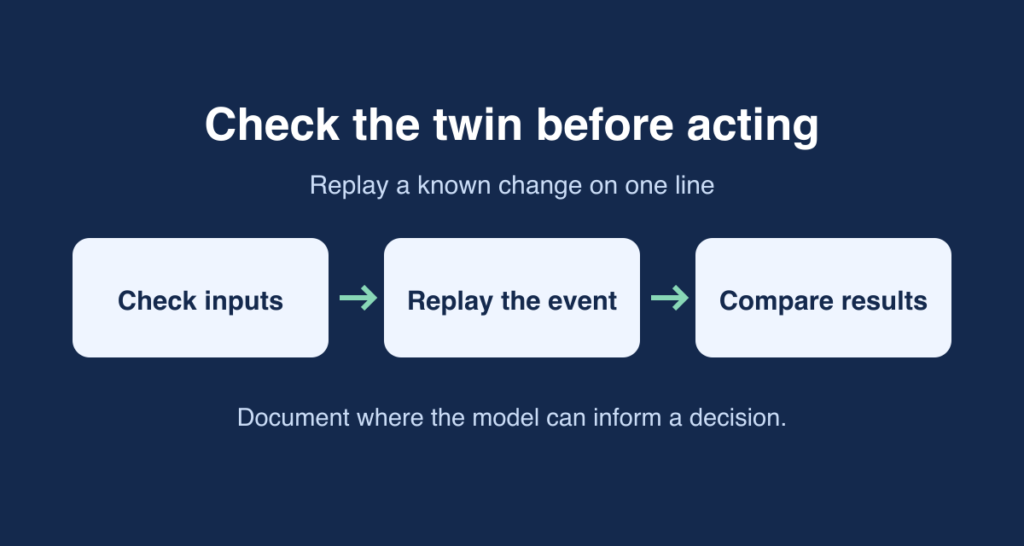
Pick one line, one change and one outcome. In this hypothetical example, use a documented filler speed change and count completed cases at the packer over a fixed interval. Agree in advance on the difference between model and measurement that would change the decision. Record any conditions that would put the comparison out of scope.
Check the inputs against the historian
Confirm that the tags refer to the same physical line and that their timestamps and units agree. Record the product format, packer state, and any stops during the comparison window. The 2026 smart manufacturing AI roadmap identifies integration across sensing and control systems as a deployment challenge. A timestamp mismatch can make the packer appear to respond before the filler changes.
Replay first, then compare
Start from the conditions before the change. Keep the observed outcome separate while setting up the replay. Compare the projection with the recorded direction, size, and timing of the response. If the twin projects more finished cases and the historian shows a growing upstream buffer instead, inspect the packer constraint and the material path before using the projection again.
Write down where the result applies
One replay gives evidence for a specific operating condition. Check another event with a different starting rate or product format before broadening the decision. The NIST digital twin workshops identify verification, validation, and uncertainty as continuing challenges. NIST’s manufacturing digital twin project uses testbeds and reference implementations to develop evaluation methods. A simple plant trial can start with the same discipline of defining the test and recording its limits.
Where CogniaWerks DMI fits
The DMI process twin uses a reviewed process graph and plant data to help engineers evaluate downstream effects. Use the graph to identify the units and signals that belong in the comparison. Have the team check the projection against the recorded evidence before approving a change. Bring a known line change to a DMI walkthrough to discuss how to set up that comparison.
References
Frechette, S., Shao, G., and Pease, M. Digital Twins Workshops Summary Report. NIST IR 8620, July 21, 2026.
Vogl, G., Cornelius, A., and Jia, X. 2026 Roadmap on Artificial Intelligence and Machine Learning for Smart Manufacturing. IOP Publishing, July 3, 2026, as listed by NIST.
NIST. Digital Twins for Advanced Manufacturing. Research project page, accessed November 16, 2026.
See DMI on your process
Book a tailored walkthrough with our team.